Trip Planning
Moalboal vs South Africa vs Magdalena Bay: Which Sardine Run Should You Dive?
Updated 23 July 2026 · 9 min read · By the Sardine Run Africa crew
Type "sardine run" into Google from the United States and the top results are not South Africa. They are Moalboal, a small town on Cebu in the Philippines, where a resident shoal of millions of sardines sits a short swim off the beach every day of the year. Same fish, same name, completely different event. One is a wildlife spectacle you snorkel before breakfast. The other is a 1,000-kilometre winter migration hunted by dolphins, sharks, whales and gannets along South Africa's Wild Coast.
Then there is a third contender that gets lumped in with both: Magdalena Bay on Mexico's Baja California peninsula, where striped marlin carve up bait balls of sardine and mackerel in open Pacific water each October to December. Divers researching one of these trips constantly end up reading about another, and plenty of people have booked the wrong one.
We run expeditions on the South African event, so read this knowing where we stand. But the fairest thing we can tell you is that all three are worth doing, for different divers, at different points in your ocean life. Here is how they compare on cost, season, difficulty, wildlife and the odds of seeing what you came for.
Moalboal: the sardine run you can walk to
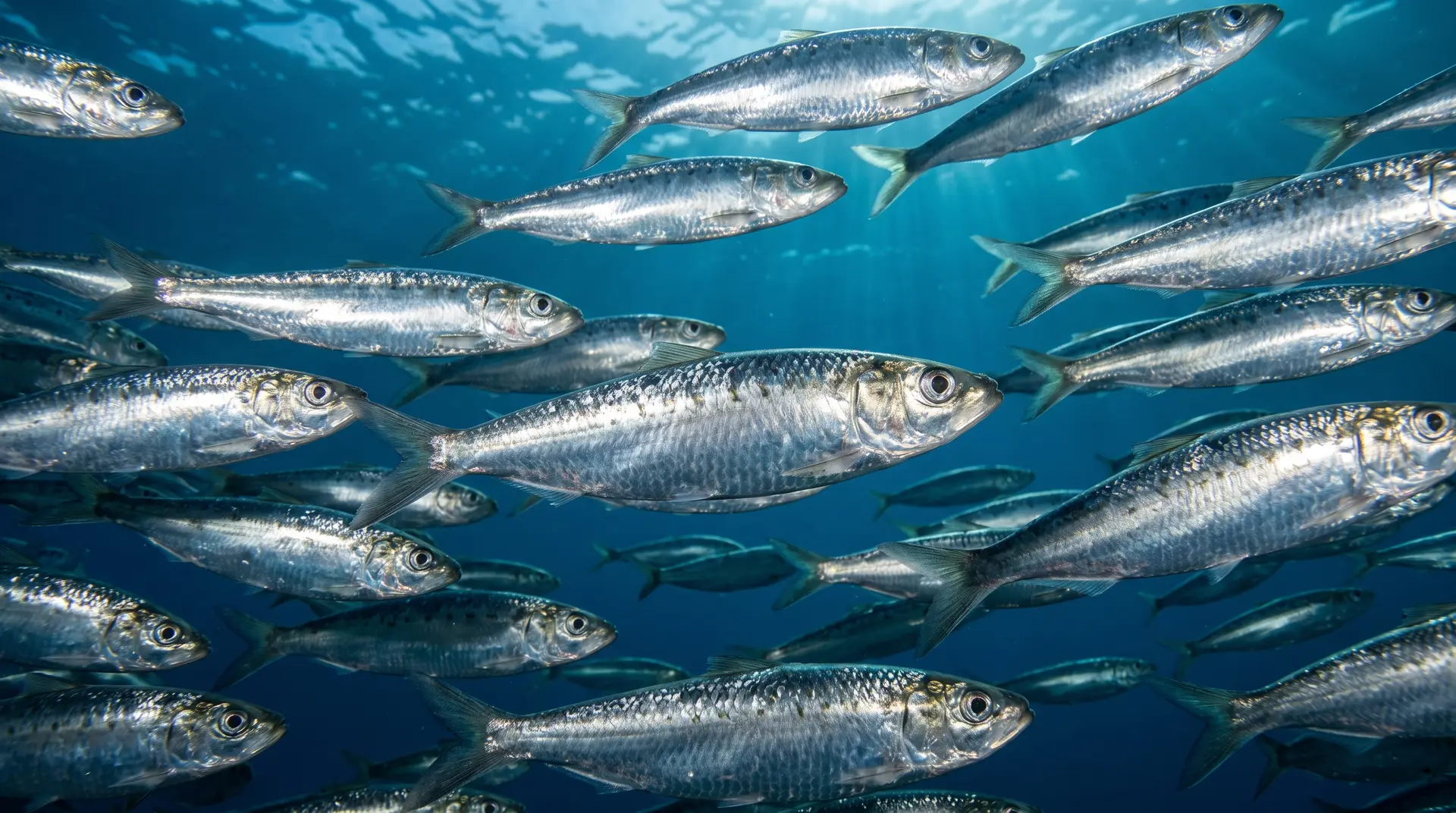
Moalboal's shoal lives off Panagsama Beach on the west coast of Cebu. It is enormous, it is photogenic, and it is there almost every day of the year. You wade in from shore, fin out over the reef edge, and within minutes you are hanging above a wall of fish that bends the light. No boat, no briefing about surf launches, no wetsuit thicker than a rash vest in warm tropical water.
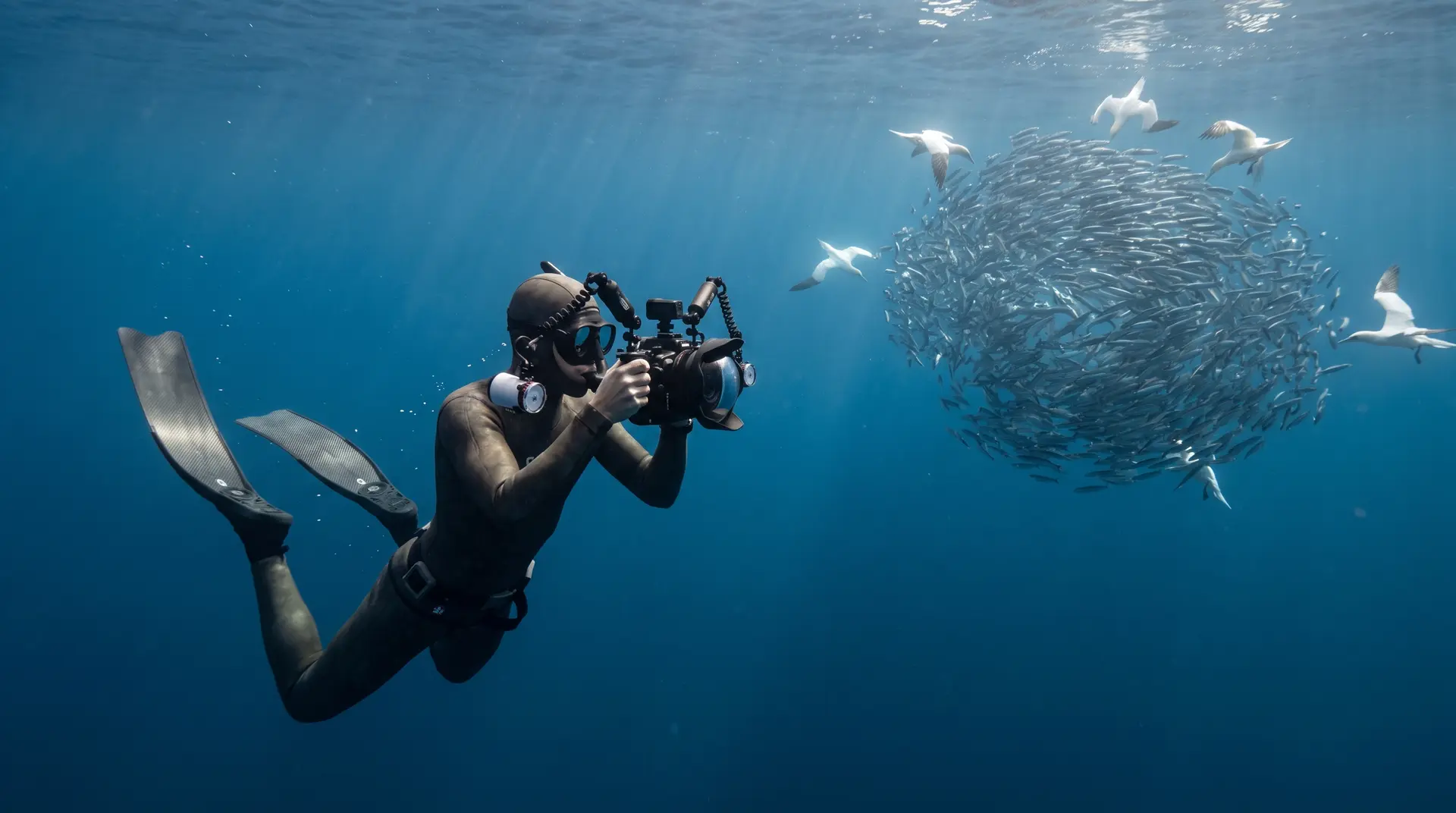
That accessibility is the whole point. Freedivers use the shoal as a backdrop for some of the most shared underwater images on the internet. Snorkellers of any ability can enjoy it. Kids can enjoy it. If your partner does not dive, they can still float on the surface and watch the shoal shimmer below them.
What Moalboal does not offer is the hunt. The shoal is resident, not migrating, and it is not being systematically worked over by predators. You will see sardines behaving like a single silver organism, which is remarkable in itself, but you will very rarely see anything eat them. There are no super-pods of dolphins herding fish, no gannets falling out of the sky, no sharks cutting lanes through a bait ball. It is a portrait, not a drama.
One more honest note: because it is easy, it is busy. Panagsama is a compact stretch of reef and the shoal draws crowds, especially mid-morning when the day-trip vans arrive from Cebu City. Go at first light and you can still have it close to yourself.
Magdalena Bay: marlin at full speed
Magdalena Bay, on the Pacific side of Baja California Sur, is the newest of the three on most divers' radar. From roughly October to December, striped marlin gather offshore to feed on bait balls of sardine and mackerel, and operators run long-range pangas out to find the action. When it works, it is astonishing: marlin lit up in hunting colours, taking turns slicing through a ball of fish while sea lions and birds pile in.
This is blue-water, boat-based snorkelling. Expect long runs offshore, hours of scanning for frigatebirds, then fast drops into open Pacific water with no bottom in sight. When the crew shouts, you slide in quickly and swim hard. Marlin do not wait. The window between finding a ball and it dissolving can be minutes, so a day's success is measured in a handful of intense encounters.
It rewards a specific kind of diver: confident in deep open water, quick over the side, comfortable being wet and cold-ish on a small boat all day. The prize is a predator interaction you cannot get anywhere else on Earth at that reliability, and in good seasons the reliability is high. The trade-off is that it is a single-species show. Marlin are the headline, the supporting cast is thin, and if the bait does not aggregate that year, there is no plan B species to fall back on.
South Africa: the migration with the full cast
The South African sardine run is the original: each austral winter, from May to July, billions of Southern African pilchards move up the east coast from the Agulhas Bank in a corridor of cool water inside the warm Agulhas Current. It is often called the greatest shoal on Earth, and by biomass it rivals East Africa's wildebeest migration. If you want the full story of the event itself, start with what the sardine run actually is.
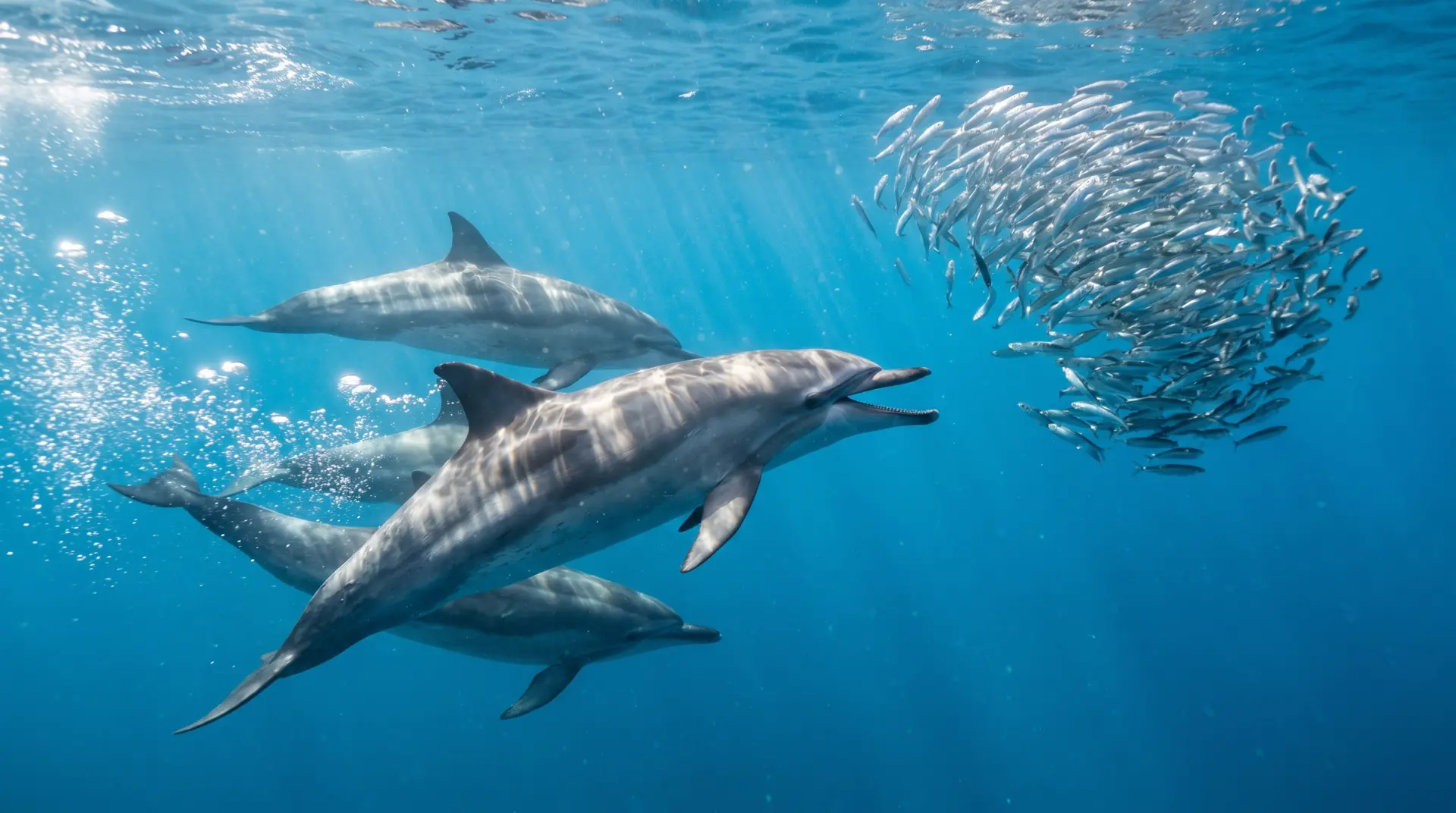
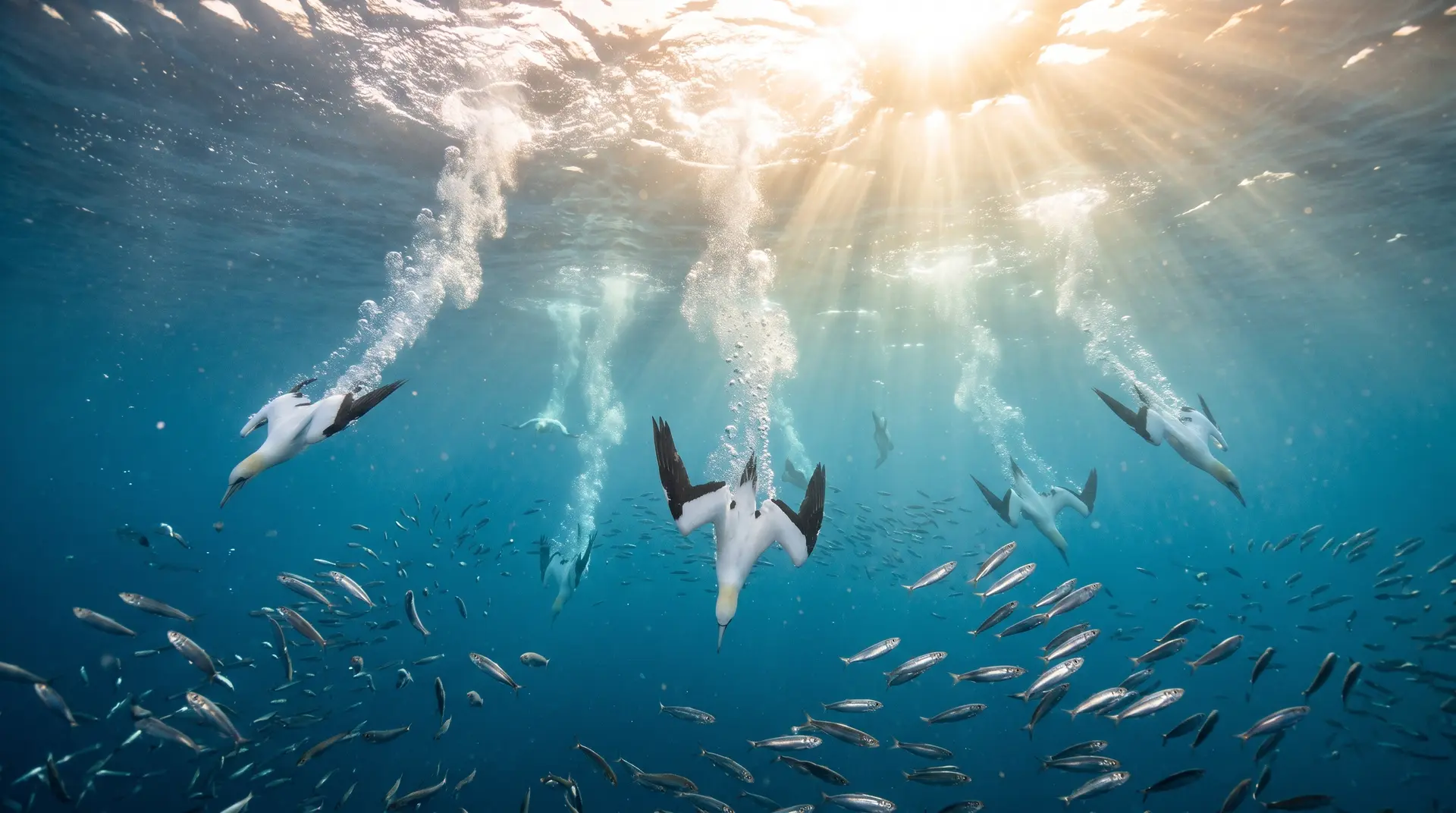
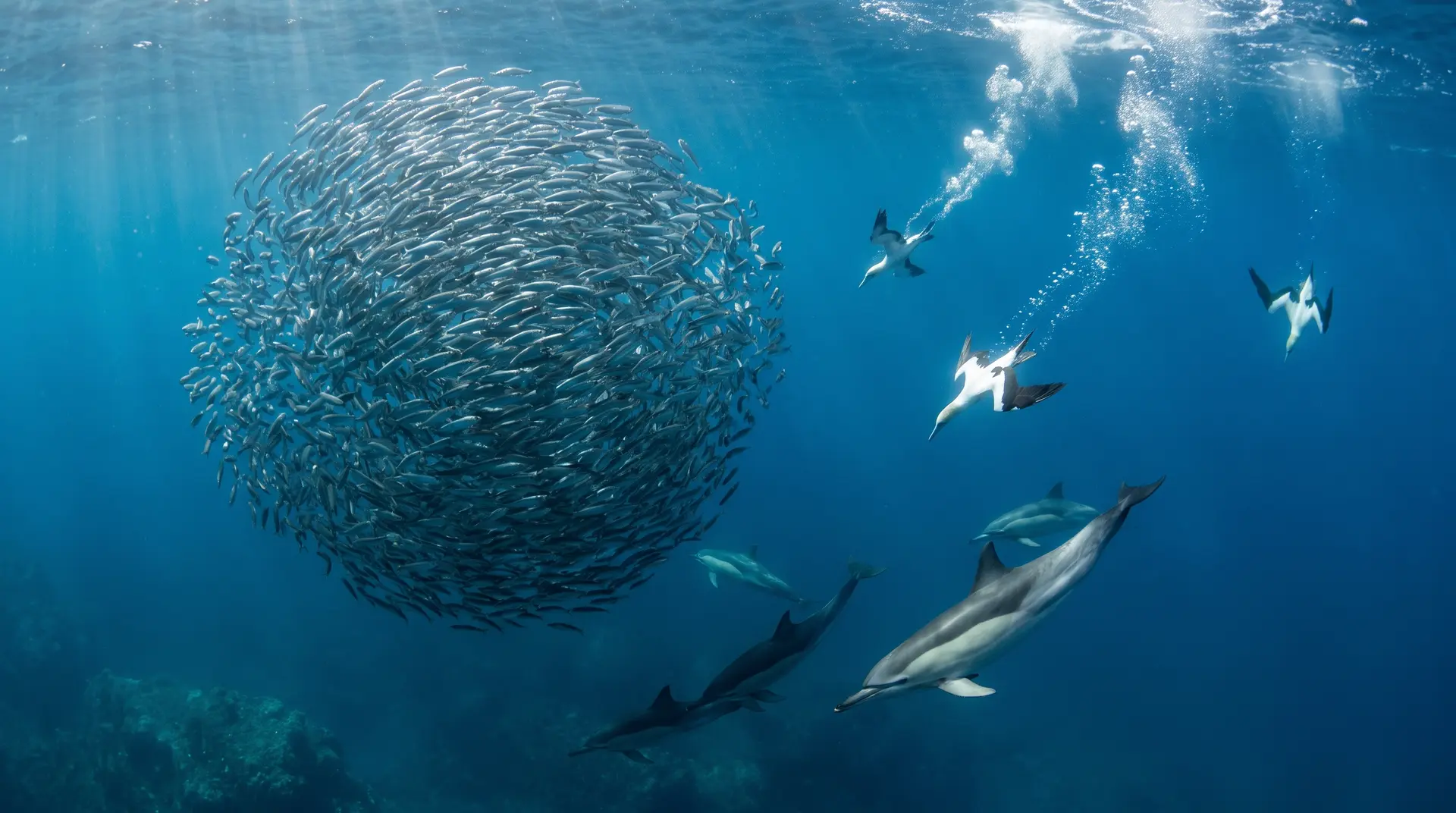
What separates it from Moalboal and Magdalena Bay is the predator cast. Long-beaked common dolphins in pods estimated up to 18,000 strong do the herding, compressing fish into bait balls typically 10 to 20 metres across. Cape gannets hit those balls from 30 metres up. Copper sharks are the signature shark of the run, joined by duskies and blacktips. Bryde's whales lunge through the middle of the action. Humpbacks migrate past almost daily, Cape fur seals work the edges, and orcas turn up occasionally. Nothing else in the ocean assembles this many hunters in one place. The full species rundown is worth reading before you come.
It is also the least predictable of the three, and any operator who tells you otherwise is selling something. Bait balls rarely last ten minutes. The run itself depends on inshore water cooling below about 21 degrees Celsius; in warm years it can arrive late or stay deep. What is dependable in season is the wider spectacle: dolphins, whales and diving gannets are seen on most sea days, and the bait ball is the jackpot on top. You are booking a wild expedition, not a scheduled show.
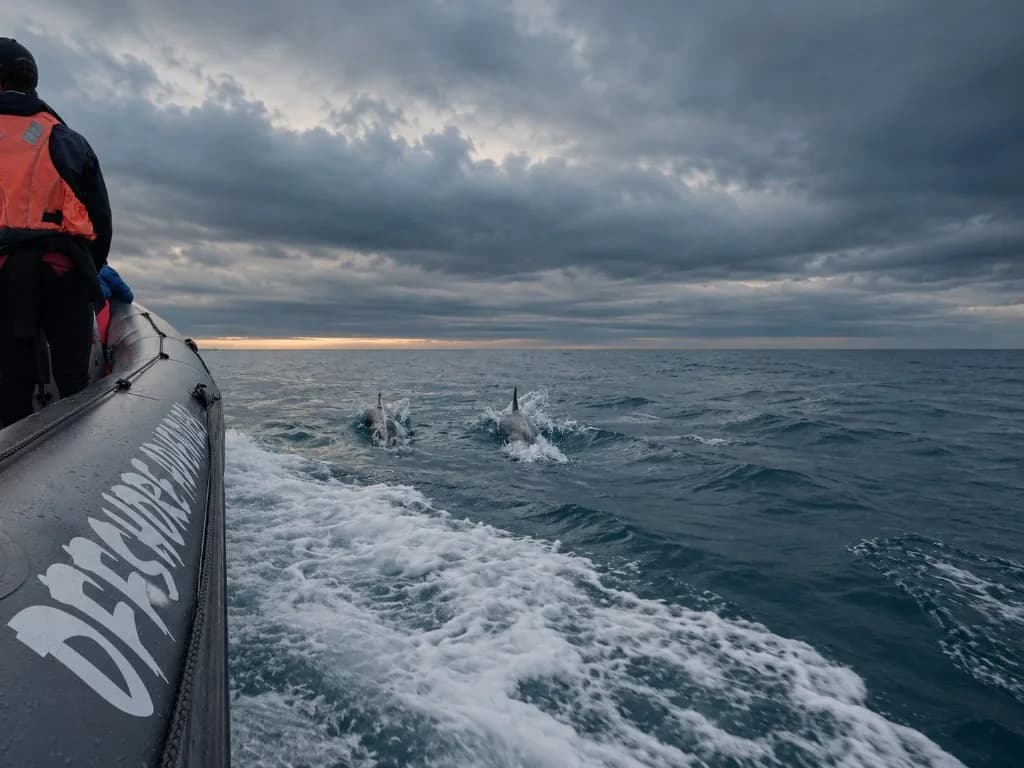
The format reflects that. This is a boat-based ocean safari: 6 to 8 hours a day on a small RIB, launching early, following bird and dolphin activity, with fast snorkel entries when the action stabilises. Scuba is used only on stable bait balls at the skipper's discretion, which is why you do not need a dive certification to join. Water runs 14 to 21 degrees, so a 5 to 7 mm wetsuit with hood and gloves replaces Moalboal's rash vest.
The three sardine runs compared
The table below is deliberately blunt. Cost figures for South Africa are current direct-operator package prices; for the other two we have kept it relative, because day rates and packages vary widely by operator and season.
| Moalboal, Philippines | Magdalena Bay, Mexico | South Africa, Wild Coast | |
|---|---|---|---|
| The event | Resident static shoal on a reef edge; no migration, predators rarely hunt it | Striped marlin hunting sardine and mackerel bait balls offshore | Migrating biomass hunted by dolphins, sharks, whales, gannets and seals |
| Season | Year-round | Roughly October to December | May to July; southern coast (East London and Chintsa) earliest, Port St Johns mid-June onward |
| Cost | Lowest by far: a shore snorkel once you are in Cebu; guided trips are cheap | Mid to high: long-range boat days add up over a multi-day trip | R27,500 to R53,000 (about $1,700 to $3,300) per person sharing for a 6 to 8 day direct-operator package |
| Difficulty | Easy; suitable for any snorkeller, including children | Moderate to hard; deep open-water drops, fast swimming, long boat days | Moderate to hard; 6 to 8 hour boat days, repeated fast entries, cold water, expedition fitness needed |
| Wildlife variety | Sardines, reef life, turtles nearby; predation events rare | Marlin as the headline; sea lions and seabirds in support | The widest cast in the ocean: common and bottlenose dolphins, Bryde's and humpback whales, copper, dusky and blacktip sharks, Cape gannets, seals, occasional orcas |
| Predictability | Near-certain; the shoal is there most days of the year | Good in season, weather permitting | Lowest; the wider spectacle is near-daily in season, but bait balls are the wild card |
| Water and gear | Warm tropical water; rash vest or thin suit | Cool Pacific blue water; 3 to 5 mm suit typical | 14 to 21 degrees Celsius; 5 to 7 mm suit, hood and gloves |
Predictability: the honest hierarchy
Rank them by the odds of seeing the headline act and the order is clear. Moalboal first, by a mile: the shoal is resident and you can check it off before your coffee goes cold. Magdalena Bay second: in a good season, operators find marlin on bait most days, though the Pacific weather decides how many days you actually get offshore. South Africa last, and every reputable operator will tell you so unprompted.
But flip the question and the ranking inverts. Ask instead: if it happens in front of me, how big is the moment? A South African bait ball with dolphins pinning fish against the surface, gannets raining down and a Bryde's whale erupting through the middle is the single most intense wildlife encounter most divers will ever have. It is the scene BBC and Netflix crews keep coming back to film. The lower probability is exactly why the payoff is what it is.
The practical response to that uncertainty is time at sea. The market consensus, and ours, is a minimum of five sea days, because the run moves in pulses and a week smooths out the quiet days. It is the same logic behind our 7-day format, and it is why the week you pick matters as much as the destination.
No honest operator guarantees a bait ball
The South African run depends on wind, currents and water temperature. Dolphins, whales and gannets are seen on most sea days in season; the full bait-ball feeding frenzy is the prize, not the baseline. Treat any operator promising guaranteed bait balls the way you would treat a safari lodge guaranteeing a leopard kill.
Difficulty and fitness: know which trip you are booking
Moalboal asks almost nothing of you physically. If you can float with a mask on, you will see the shoal. That is a feature, not a criticism, and it is the reason we point casual snorkellers and families there without hesitation.
Magdalena Bay and South Africa are working trips. Both involve long days on small boats in open ocean, repeated fast entries over the side, hard surface swimming to keep up with moving animals, and climbing back aboard unaided, again and again. South Africa adds cold: winter air of 14 to 21 degrees, similar water, and thick neoprene that makes every re-entry heavier. You do not need to be an athlete, but you need moderate fitness and real comfort in open water. We wrote a full fitness and preparation guide for exactly this, and we would rather you read it six weeks out than discover the boat ladder on day one.
On certification: none of the three requires scuba. Moalboal and Magdalena Bay are snorkel events almost entirely. The South African run is snorkel-first too, with scuba reserved for stable bait balls, so non-divers lose very little and boat-based guests still get the whales, dolphins and bird strikes from the surface.
Our verdict: match the trip to the diver
Book Moalboal if you want a beautiful, low-effort, near-guaranteed encounter with a massive shoal, or you are travelling through Southeast Asia anyway, or you are introducing kids or a nervous snorkeller to big marine spectacles. It is the best value-for-effort sardine experience on the planet, and pretending otherwise would insult your intelligence.
Book Magdalena Bay if striped marlin are your animal. It is a focused, athletic, single-species hunt in blue water, and between October and December nothing else delivers billfish on bait like it.
Book South Africa if you want the migration itself: the event the phrase "sardine run" was coined for, with the full predator cast and the possibility of the most intense ten minutes of your diving life. Come in May or June and the action starts on the southern coast around East London and Chintsa, which is where we launch, 40 minutes from a proper airport with direct flights from Johannesburg and Cape Town. Our next bookable season is 2027, and the boats carry small groups, so the 7-day expedition packages are worth looking at early rather than in the new year.
Plenty of divers do all three eventually. If that is the plan, our advice is simple: do Moalboal whenever it is convenient, do Magdalena Bay when you are swim-fit, and give South Africa a full week of your life while your shoulders can still haul you over a pontoon eight times a day.
Frequently asked questions
Is the Moalboal sardine run the same as the South African sardine run?
No. Moalboal has a resident, non-migrating shoal that lives off Panagsama Beach year-round and is rarely hunted by predators, so you snorkel it from shore in warm water. The South African run is a May-to-July migration of billions of sardines pursued by dolphins, sharks, whales and gannets, accessed by boat expedition on the Wild Coast.
Which sardine run is best for beginners or non-divers?
Moalboal, without question. It is a calm shore snorkel in warm water that any swimmer can manage. The South African run welcomes non-divers too, since most action is watched from the boat or joined on snorkel, but it demands moderate fitness, cold-water gear and long days at sea.
Can I see predators hunting sardines in Moalboal?
Very rarely. The Moalboal shoal is resident and predation events are the exception, not the draw. If watching dolphins, sharks, gannets and whales actively hunt is the point of your trip, South Africa is the destination built around it, and Magdalena Bay is the marlin-specific alternative.
When do the three sardine runs happen?
Moalboal is year-round, since the shoal is resident. Magdalena Bay's striped marlin season runs roughly October to December. South Africa's run is May to July, starting on the southern coast near East London and Chintsa in May and June before moving north toward Port St Johns.
Is Magdalena Bay or South Africa better for underwater photographers?
They solve different briefs. Magdalena Bay offers repeatable, well-lit blue-water frames of a single spectacular species, which is easier to plan a portfolio around. South Africa offers the rarer, messier, once-in-a-career frame: a multi-species feeding frenzy. Many working photographers shoot Magdalena Bay for reliability and keep returning to South Africa for the shot they have not got yet.
How much more does the South African sardine run cost than Moalboal?
A lot, and it should. Moalboal is essentially a shore snorkel once you are in Cebu. A South African expedition is a crewed small-boat operation with skipper, guides, fuel-heavy sea days and full packages, with direct-operator 6 to 8 day trips running about R27,500 to R53,000 (roughly $1,700 to $3,300) per person sharing.
Keep reading
Ready for the migration, not the postcard?
If the full predator cast is what you are after, the 2027 season is the next one you can book. Our 7-day expeditions launch from Chintsa on the southern Wild Coast, 40 minutes from East London's King Phalo Airport, where the run arrives first each season. Boats carry small groups and prime weeks go early, so ask us anything on the contact page or compare the packages now.
Boats carry small groups only, and prime weeks go 6-12 months out.